The Cloud Reading Blog
Short histories of looking up, for curiosity.
People have read the sky for thousands of years: as omens, as weather, as art and, lately, as a game of imagination. These are brief stories about the people and ideas along the way. We have tried to say plainly where the evidence is firm and where it is thin, but they are meant for enjoyment, not as a substitute for the original sources.
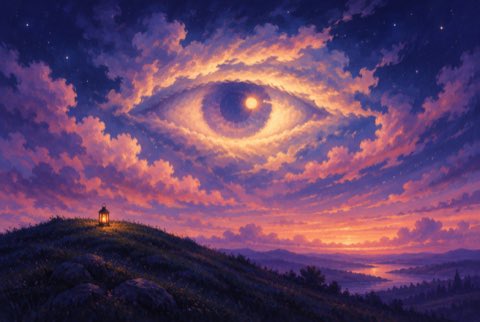 What is nephomancy?
Nephomancy is the old word for divination by clouds. Here is where it comes from, and what it has and has not been.
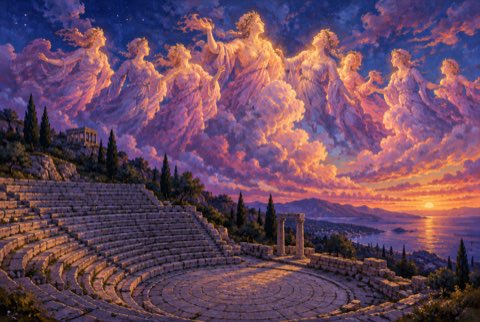 Aristophanes gave the clouds a chorus
In 423 BC an Athenian comedy turned the clouds into goddesses who can become anything they like, and put philosophy on trial.
 Aristotle and the first weather watchers
Greek thinkers began treating clouds as part of nature rather than messages from the gods, and learned to read them for weather.
 Sky omens of ancient Babylon
Mesopotamian scribes collected thousands of omens from the heavens and the weather, but they were not reading cloud shapes the way we imagine.
 Watching the clouds in Han China
In early China, cloud-watching, known as yunqi, was part of a system of lucky and unlucky signs, written in manuscripts and painted on silk.
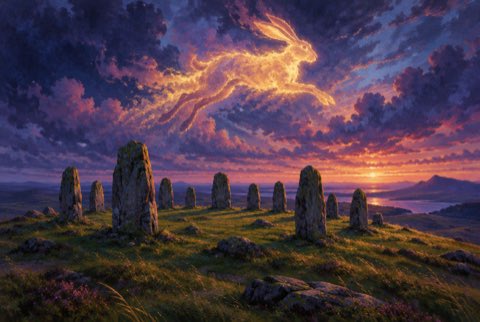 Did the druids read clouds?
Medieval stories give druids the power to divine from clouds, but historians doubt the practice is as ancient as the stories claim.
 Hamlet, Polonius and the whale-shaped cloud
Shakespeare knew the game: in Hamlet a prince tricks a courtier into agreeing that one cloud looks like three different animals.
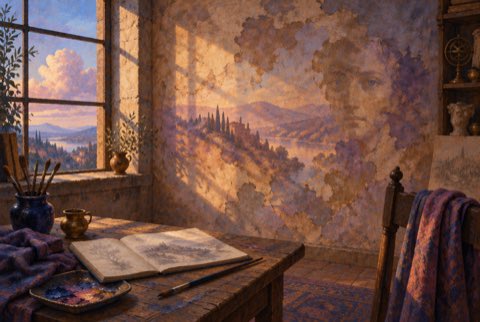 Leonardo's advice: look at the stains
Leonardo da Vinci told young painters to stare at stained walls and drifting clouds until landscapes and battles appeared, and an English artist took the idea further.
 Luke Howard, the man who named the clouds
In 1802 an amateur London weatherman gave clouds Latin names, and the words cirrus, cumulus, stratus and nimbus have never left the sky.
 Goethe wrote poems to the clouds
The German poet Goethe was so taken with Luke Howard's cloud names that he wrote a set of verses in his honour, one for each cloud form.
 John Constable and the art of "skying"
In 1821 and 1822 the English painter John Constable made dozens of small oil studies of clouds, writing the date, hour and wind on the back.
 Why we see faces in clouds
The habit of finding faces and animals in clouds has a name, pareidolia, and researchers think it says more about our brains than about the sky.
 Stieglitz and the clouds called Equivalents
In the 1920s the photographer Alfred Stieglitz pointed his camera at the sky alone and called the results Equivalents, pictures of feeling.
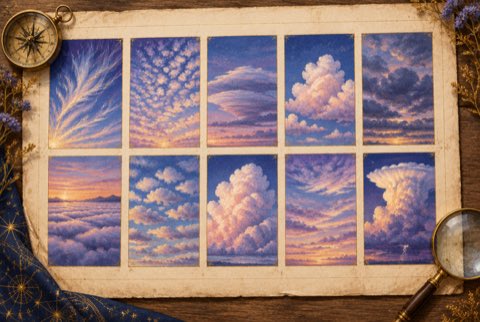 The International Cloud Atlas
How scientists turned Luke Howard's idea into a worldwide standard, from ten basic cloud types in the 1880s to a digital atlas that still adds new names.
 Gavin Pretor-Pinney and the cloud lovers
A writer's campaign to persuade us that clouds are not a nuisance became a society of cloud lovers and helped win official recognition for a new cloud.