Shakespeare knew that clouds can look like anything. In Hamlet, in the third act, the prince is trying to show how easily the old courtier Polonius will agree with whatever he is told. So he points at the sky.
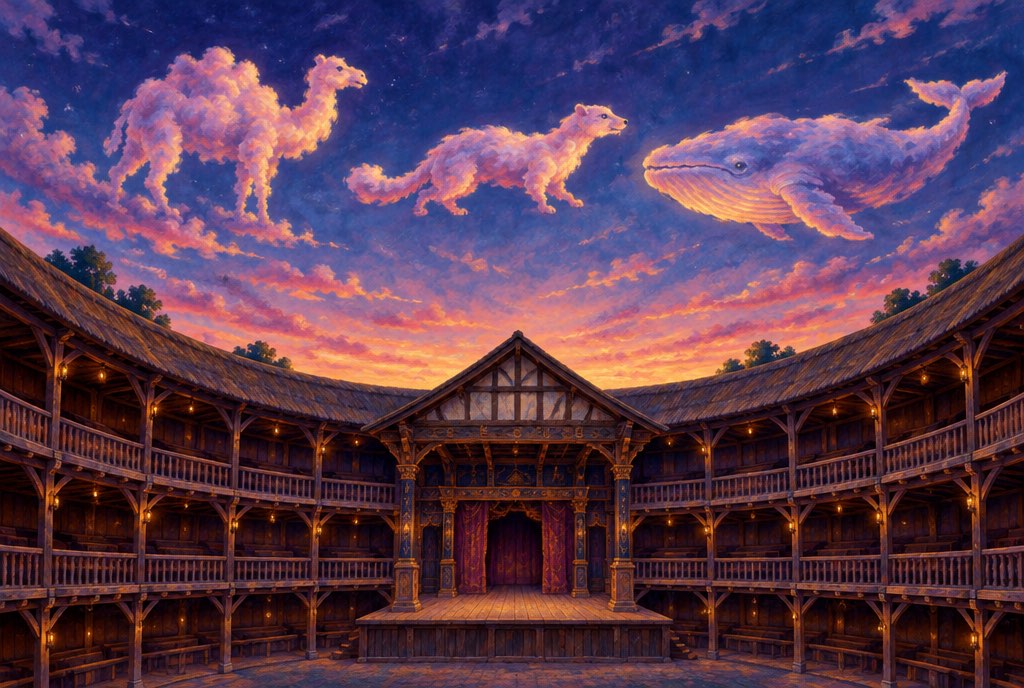
"Do you see yonder cloud that's almost in shape of a camel?" Hamlet asks. "By th' mass, and 'tis like a camel, indeed," says Polonius. "Methinks it is like a weasel," says Hamlet. "It is backed like a weasel." "Or like a whale?" "Very like a whale."
The joke is about flattery, since Polonius will see whatever the prince wants him to see. But it only works because the audience already knew that a cloud can be a camel, a weasel or a whale, depending on who is looking. Cloud-gazing was clearly familiar enough in Elizabethan London to be a gag.
Shakespeare returns to the idea more gently in Antony and Cleopatra, where Antony speaks to Eros of the sky: "Sometime we see a cloud that's dragonish; a vapour sometime like a bear or lion, a tower'd citadel, a pendent rock." He goes on to say that the shapes dissolve into the air as we watch. In Antony's mouth, a cloud is a picture of how a life can lose its outline.
Both scenes are useful for anyone who reads clouds today. The first reminds you that an image can say more about the viewer than about the sky. The second reminds you that the image will not stay. Perhaps that is why it works so well as a moment of reflection.