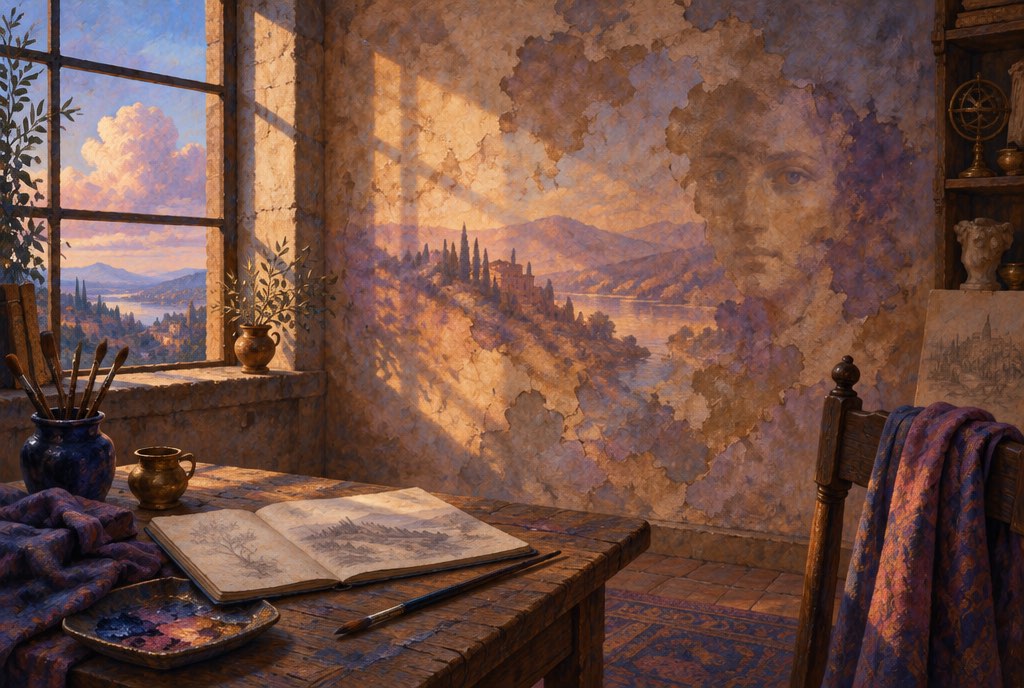
Leonardo da Vinci, writing notes for painters around the turn of the sixteenth century, offered an odd tip for finding ideas. Look at a wall splashed with stains, he said, or at stones of mixed colours, and let your mind work. You might see landscapes with mountains and rivers, battles, strange faces, or costumes. In the same passage he lists the ashes of a fire, clouds and mud among the things that can set the imagination moving.
He understood that the mind meets confusion halfway. A muddle of shapes gives it nothing to resist, so it makes something up. He compared it to the way you can hear any word you like in the sound of bells. Leonardo did not call this magic. He called it a way to wake up invention, though some of his readers have always heard a hint of something more mystical.
The idea travelled. In the 1780s the English landscape painter Alexander Cozens published A New Method of Assisting the Invention in Drawing Original Compositions of Landscape. His students began with accidental blots of ink, made quickly and without thinking, then looked for scenery in them and drew it out. Cozens had in effect turned Leonardo's wall into a teaching exercise.
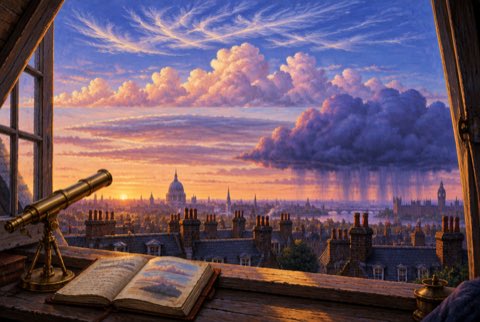
Cloud reading belongs to the same family. A cloud is an accidental blot on the largest wall there is. The shape belongs to no one, so anyone may find something in it, and what they find tends to be about them. We find that a gentle comfort: you do not need to be an expert to start, only willing to look for a moment longer than usual.