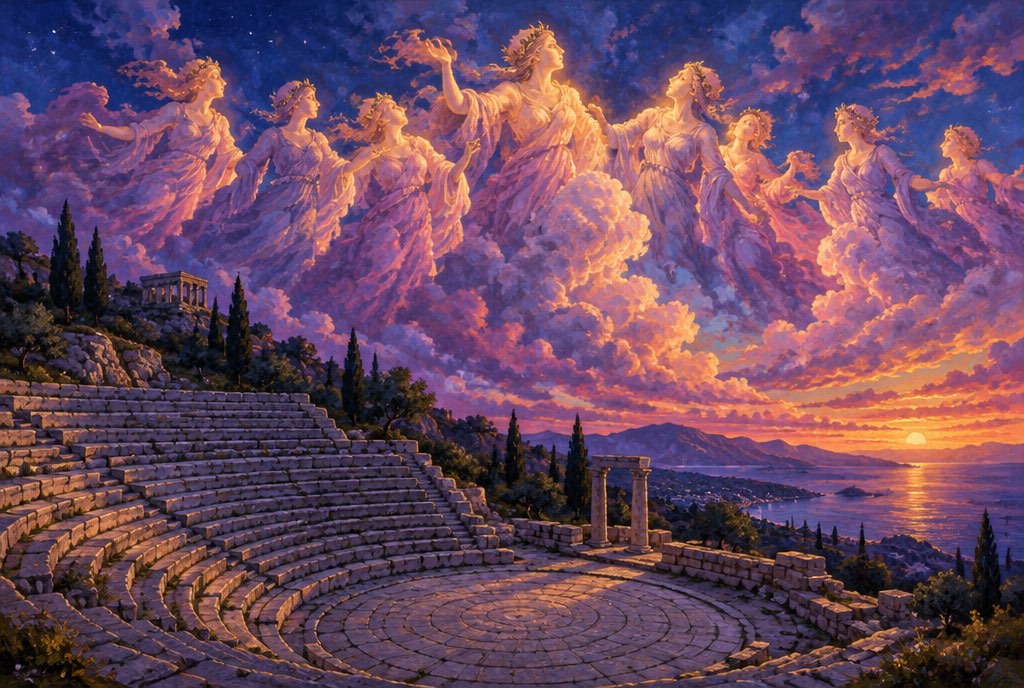
The earliest famous cloud-watcher in Western literature is a comic one. In 423 BC the Athenian playwright Aristophanes staged The Clouds at the City Dionysia, the great spring drama festival. The play came third, and Aristophanes later revised it. The version that survives is that revised text.
The plot follows Strepsiades, a farmer buried in debt, who hopes to learn clever arguments that will let him dodge his creditors. He sends his son to the Thinkery, a school run by Socrates, who appears in the play dangling in a basket so that he can study the sky. Socrates tells his visitor to worship not Zeus but the Clouds, which he calls the true goddesses of thinkers.
The Clouds arrive as the chorus, singing and drifting across the stage. Socrates explains that they take whatever shape they like. If they spot a shaggy, wild-looking man, they become centaurs. If they see a greedy thief, they turn into wolves. The joke is that clouds mirror whoever is looking up at them. That, remarkably, is the very idea behind every cloud reading since.
Aristophanes was not teaching divination, and his Socrates is a caricature. Plato later suggested that the comedy helped feed the suspicion that led to the philosopher's trial. But Aristophanes captured something people have always felt: a cloud can seem to change to suit your mood, your fears and your character. When you read a sky today, you are playing a much older game than you might think.